
The Story Behind the Shot: Aligning the Super Harvest Moon Over Mt. Hood
As a fine art landscape photographer, people often ask me how much of my work is "being in the right place at the right time" versus meticulous planning. The truth? Being in the right place at the right time is almost always the result of hours of meticulous planning.
Last fall, I captured a photo of the Super Harvest Moon rising perfectly behind the peak of Mt. Hood, framed by the blooming dahlia fields right here in my hometown of Canby, Oregon. The response to the image was completely overwhelming—but the real story is the preparation that made that single fraction of a second possible.
Here is exactly how I planned and executed my favorite alignment of the year.
The Vision: Two Oregon Icons
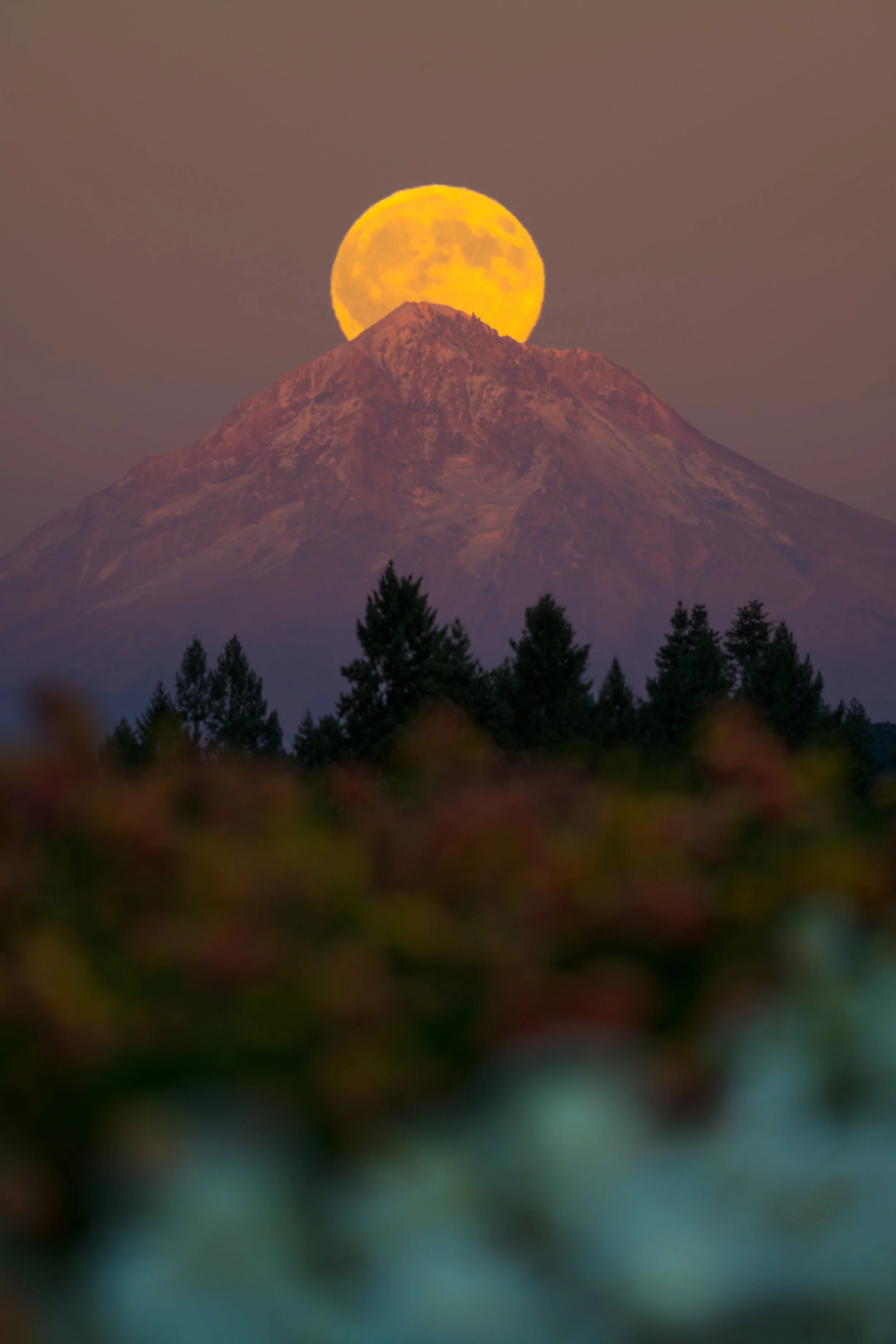
The Full Harvest Moon Rising above Mt. Hood.
I knew I wanted to capture something that felt quintessentially "Pacific Northwest." The Swan Island Dahlia fields in Canby are world-famous, and late summer/early autumn provides the perfect window where the fields are exploding with color. My goal was to compress those vibrant foreground flowers against the colossal scale of Mt. Hood, all while a 100% full moon crested the summit.
To pull this off, I needed perfect weather, perfect timing, and the right tools.
The Tools of the Trade: Planit Pro
You cannot guess a mountain alignment. The moon moves across the sky incredibly fast, and if you are standing even a few hundred feet in the wrong direction, it will rise beside the mountain instead of directly over the peak.
To guarantee the shot, I rely heavily on an app called Planit Pro.
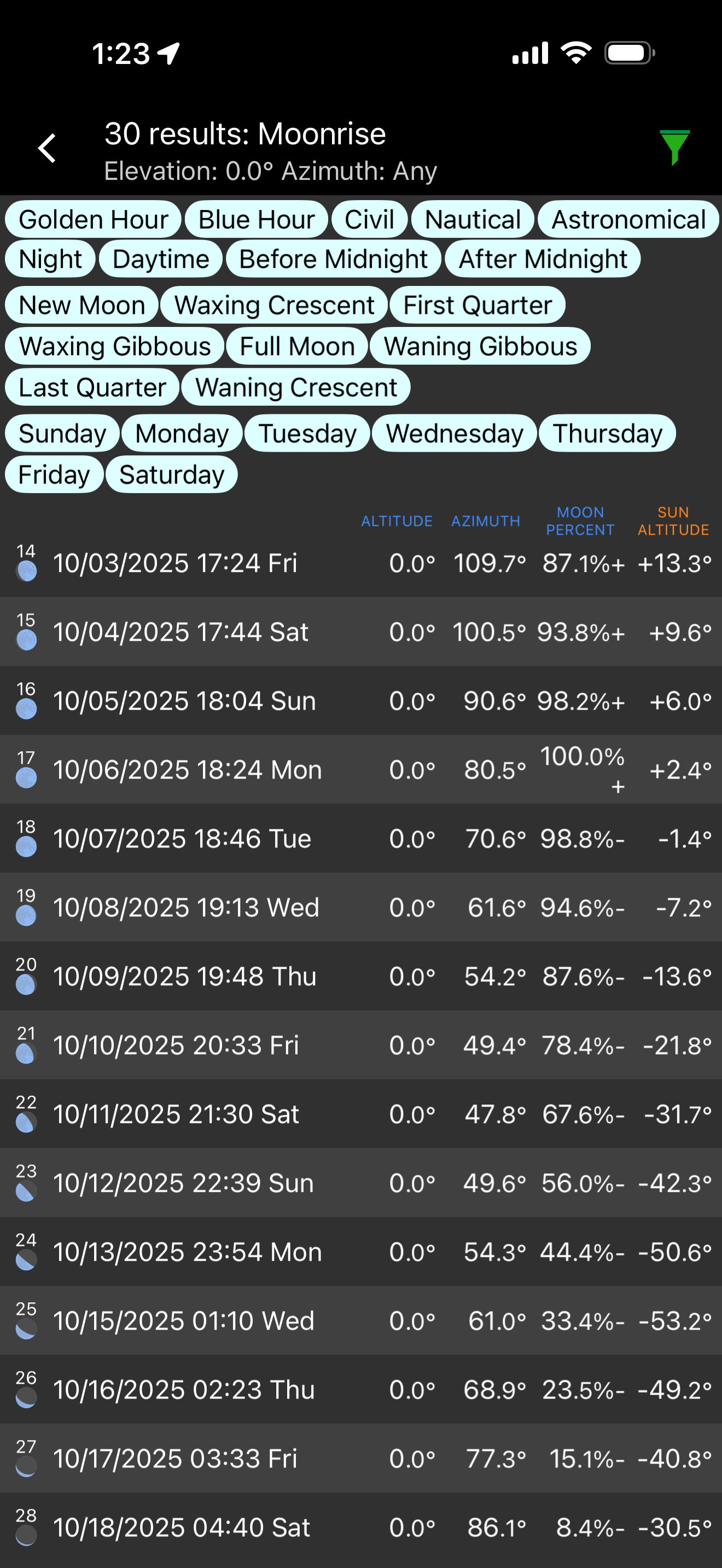
Searching for the Moonrise
1. Finding the Perfect Date
First, I had to track the lunar calendar. I needed a moon that was at 100% illumination (a true full moon) rising right around sunset so there would still be enough ambient light to capture the color of the dahlias and the alpenglow on the mountain. My data showed that October 6, 2025, would provide exactly that.
2. The Viewfinder VR Alignment
Once I had the date, I used Planit Pro’s Viewfinder VR feature to digitally simulate the landscape. I placed my virtual camera pin in the Canby dahlia fields (in this case on the side of the road) and aimed it at Mt. Hood.
The app allowed me to see exactly where the moon would intersect with the topography of the mountain.
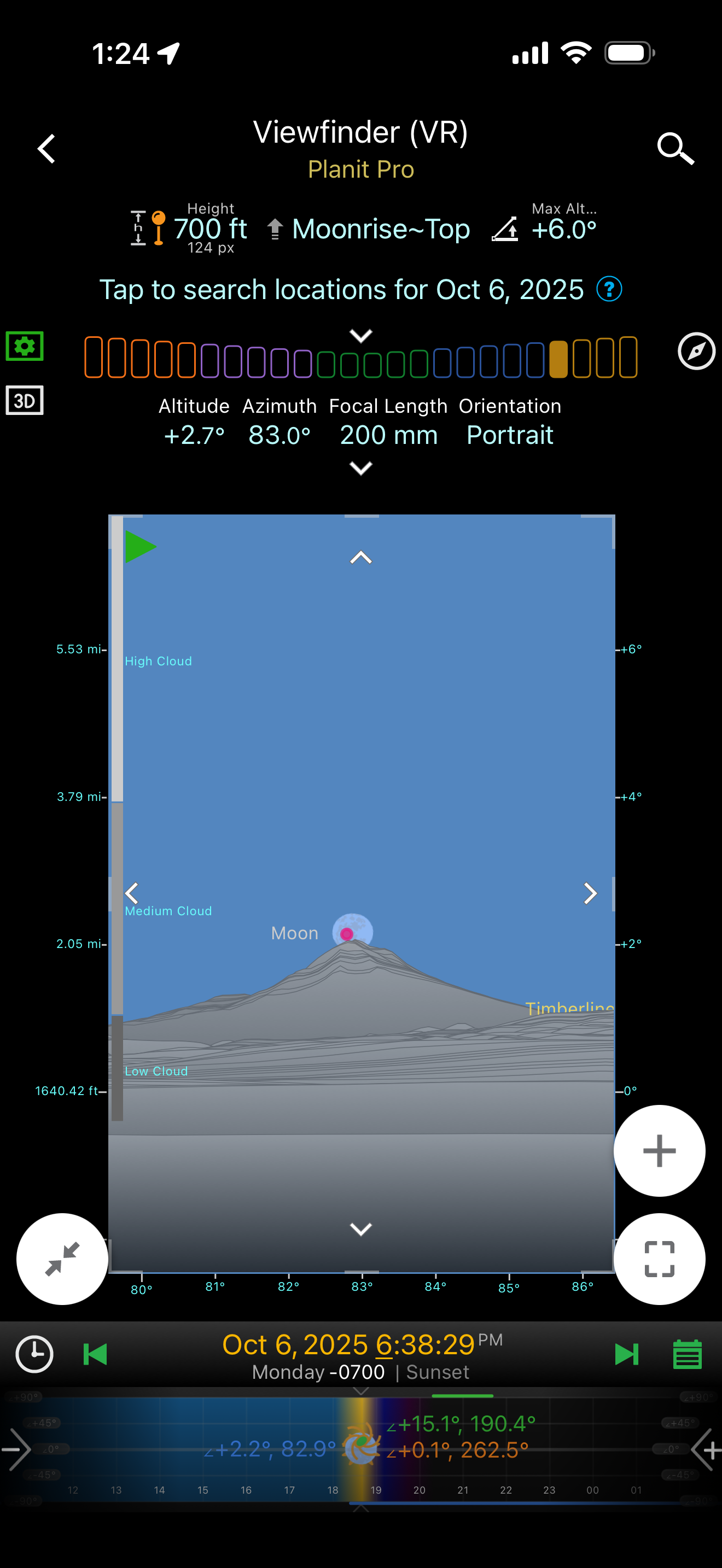
After fine-tuning my exact GPS coordinates in the field, Planit Pro gave me the golden numbers:
• The Focal Length: I needed to shoot at 200mm to create the "lens compression" required to make the moon look massive against the mountain peak.
• The Exact Time: The app predicted the moon would crest the absolute center of Mt. Hood’s summit at precisely 6:38:29 PM.
The Execution:
On the evening of October 6th, I set up my tripod on the side of the road overlooking the white and orange dahlias. The sky had shifted into a beautiful, soft gradient of twilight pinks and purples.
When you are waiting for a moonrise, there is always a moment of nervous anticipation. You trust the math, but you are still staring at an empty peak.
Then, right on schedule, exactly as the app predicted, the glowing orange rim of the Super Harvest Moon pierced the snow-capped summit of Mt. Hood. Because I was at 200mm, the moon looked absolutely colossal. I had only a few brief seconds to trigger the shutter before the moon detached from the mountain and floated up into the twilight sky.
When preparation meets perfect natural conditions, the result is pure magic.
Bring the Magic Home
Because of the incredible response to this image, I have officially added "Mt. Hood Dahlia Moonrise" to my Open Edition fine art print collection.
If you want to bring this peaceful, meticulously planned Pacific Northwest moment into your own space, it is now available as a museum-grade archival paper print, crafted directly by me in my Canby studio.
Shop the Mt. Hood Dahlia Moonrise Print
Thank you for following along. If you would like to learn more feel free to contact me!