
There are CMEs headed toward Earth and a real shot at aurora tomorrow night. If you've been waiting for a reason to learn the Aurora screen, this is it.
Every so often the Sun throws a punch — a coronal mass ejection, a billion tons of magnetized plasma flung out into space. When one lands squarely on Earth, the sky glows. Right now there are CMEs inbound and the forecast is lit up for tomorrow night. So let's talk about the Aurora screen in GoldenLight, because it was built for exactly this moment.
I designed it to answer the only two questions a photographer actually has: Will I see it from where I'm standing, and when's the window? Everything on the screen ladders up to those two answers.
Start with the chip
On your Home screen, the AURORA chip gives you the glance version: Kp, Bz, and a plain-language status — Quiet, Watch, Active, or Go Now — plus a gold line when there's a CME inbound. When that status climbs, tap in.
Your odds, not Canada's
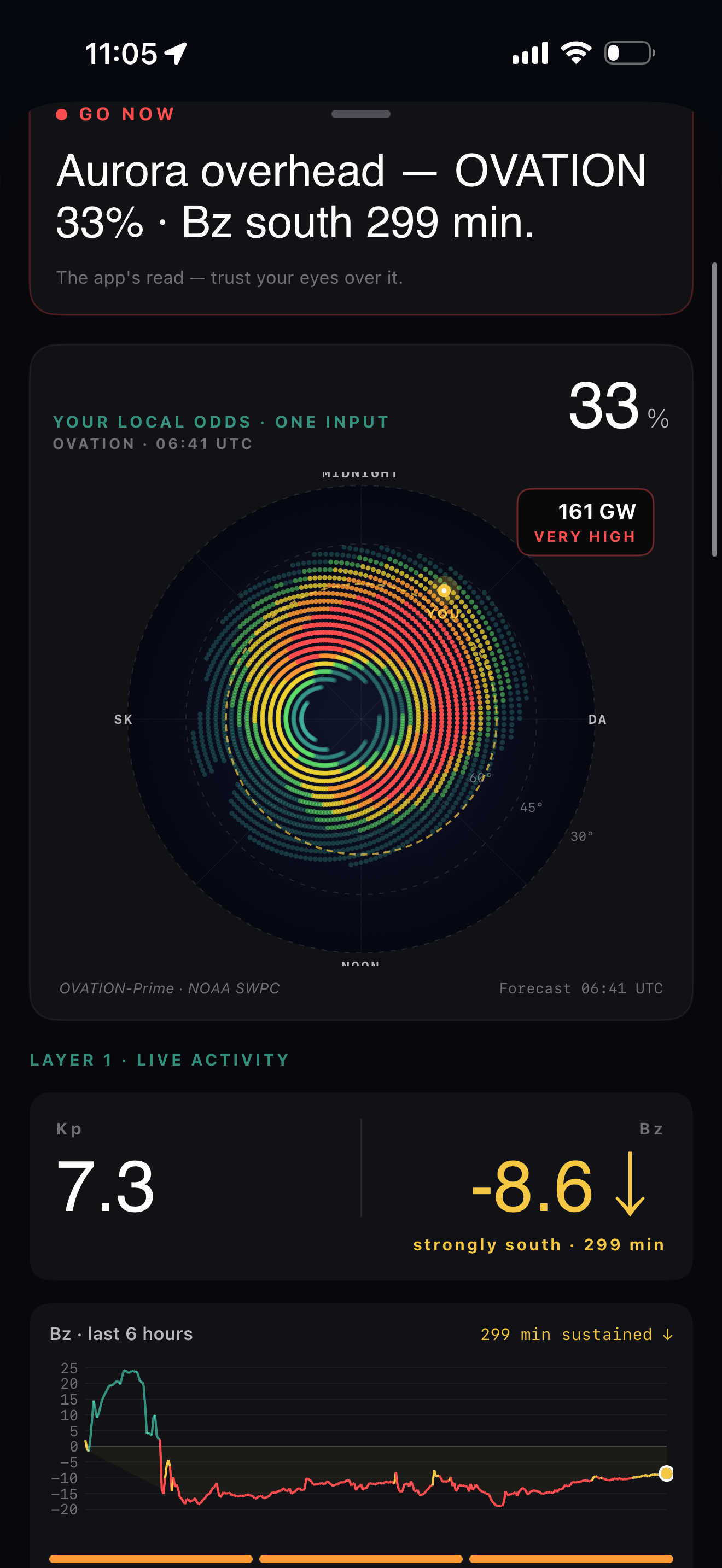
The first thing the sheet shows is your local odds — not a generic "Kp 6 somewhere up north," but the probability of visible aurora at your pin, sampled from NOAA's OVATION model. Below it, a polar map draws the auroral oval with a gold dot for where you are. If that dot is tucked under the green, you're in the game.
The two numbers that matter
Kp is the headline activity level, 0–9. Higher is more — a solid at-a-glance gauge.
Bz is the one seasoned chasers actually watch. It's the direction of the Sun's magnetic field as it reaches us, and when it swings south (negative), the door to Earth's magnetosphere swings open and energy pours in. A strong, sustained southward Bz can matter more than a big Kp. The sheet shows both, with a six-hour Bz trend chart so you can see which way the wind's blowing.
What's inbound
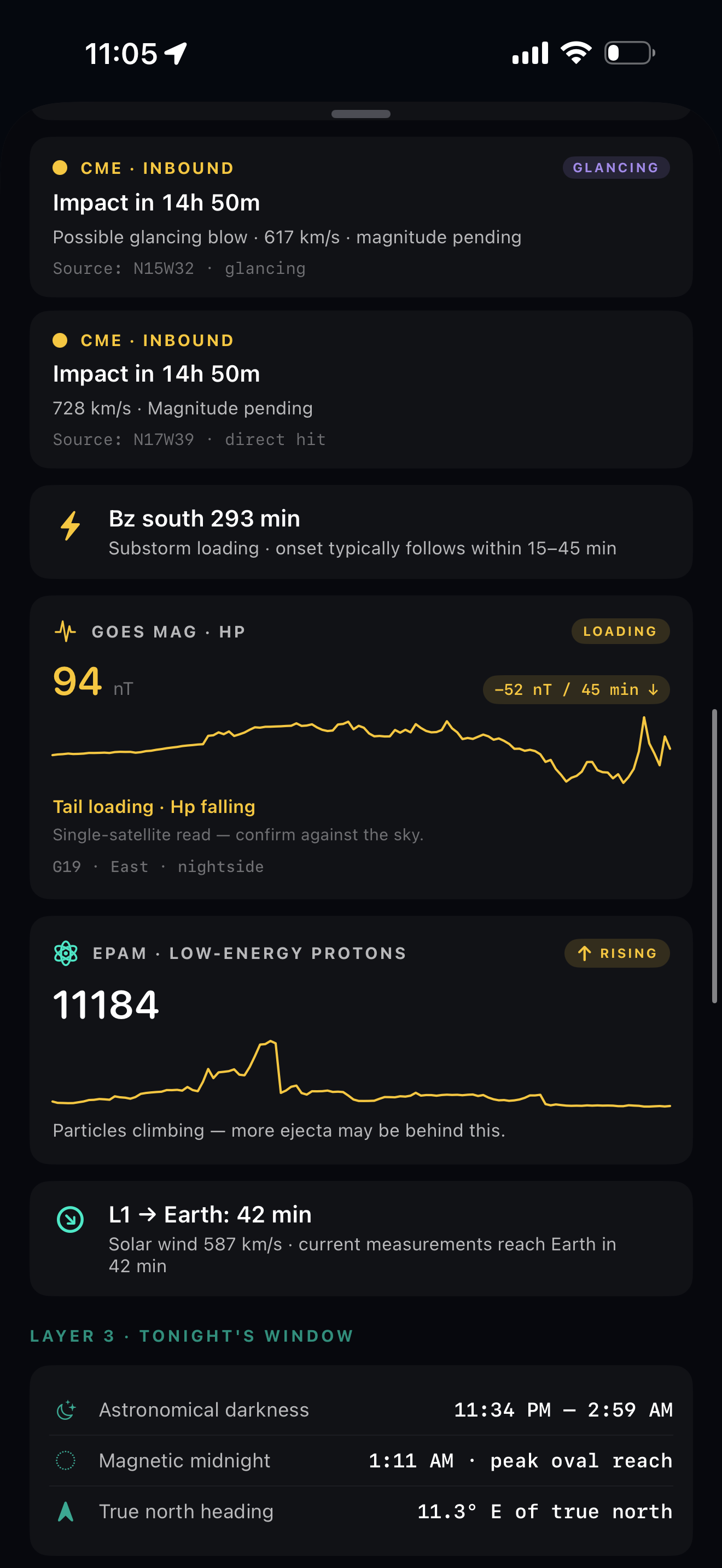
Here's the timely part. When a CME is on the way, it gets its own card with a live countdown to arrival, and it tells you whether it's a direct hit or a glancing blow. Once it lands, the card flips to Arrived and reads back how hard it actually struck out at the L1 spacecraft — a faint bump versus a real shock front. The app also watches the GOES magnetometers for substorm onset: that sudden brightening that makes everyone in the field gasp and reach for the remote.
One honesty note, because it matters: space weather is a probability, not a promise. The app gives you the odds and the ingredients — and if a data feed goes dark, it says "no live data" rather than a false "quiet," because a silent sensor isn't a calm sky. Trust the readings. Trust your eyes more.
Green, red, or purple?
Further down is the Color Forecast — our read on how likely each color is tonight, based on the incoming energy and your latitude. Green is the common curtain; red and purple ride higher and need a stronger storm. It's always labeled a forecast, never "measured" — it's telling you what to hope for.
The window
Aurora doesn't care about golden hour. Tonight's Window finds the overlap of three things: astronomical darkness, magnetic midnight (when the oval reaches farthest toward you), and the moon being down. That intersection is your best shot. Right below it sit a moon card (a bright moon washes faint aurora out) and a cloud card — because none of this matters if you're socked in.
Point north, correctly
When you're set up, the sheet hands you a true-north heading, corrected for magnetic declination (~15° here in Oregon). Anchor a foreground to the north and let the sky do the work.
How to use it tomorrow night
Set your monitored pins now — your favorite dark spots. The location dropdown pulls from them, so you can compare odds across locations before you ever start the truck.
Watch the verdict, Bz, and the CME countdown. South Bz + a CME arriving after dark is the combination you want.
Read the window — confirm dark, moon-down, and clear.
Keep a plan B. Clouds move; a second monitored pin an hour away can save the night.
The forecast can always fizzle — that's the nature of chasing the Sun. But the nights it doesn't are the ones you'll be telling people about for years. Update to the latest beta, open the Aurora chip tonight to get familiar with it, and if the numbers hold, get yourself somewhere dark tomorrow.
Then send me what you catch.
Andy